OPINION: A New Inner Circle: How Moral Clarity and Ground Truth Are Shaping America’s Path to Peace in Ukraine
The world is watching. The stakes could not be higher. President Trump must rely on the wiser, more seasoned voices advising him in this nascent peace process.
 Originally published at Kyiv Post on Apr 28, 2025
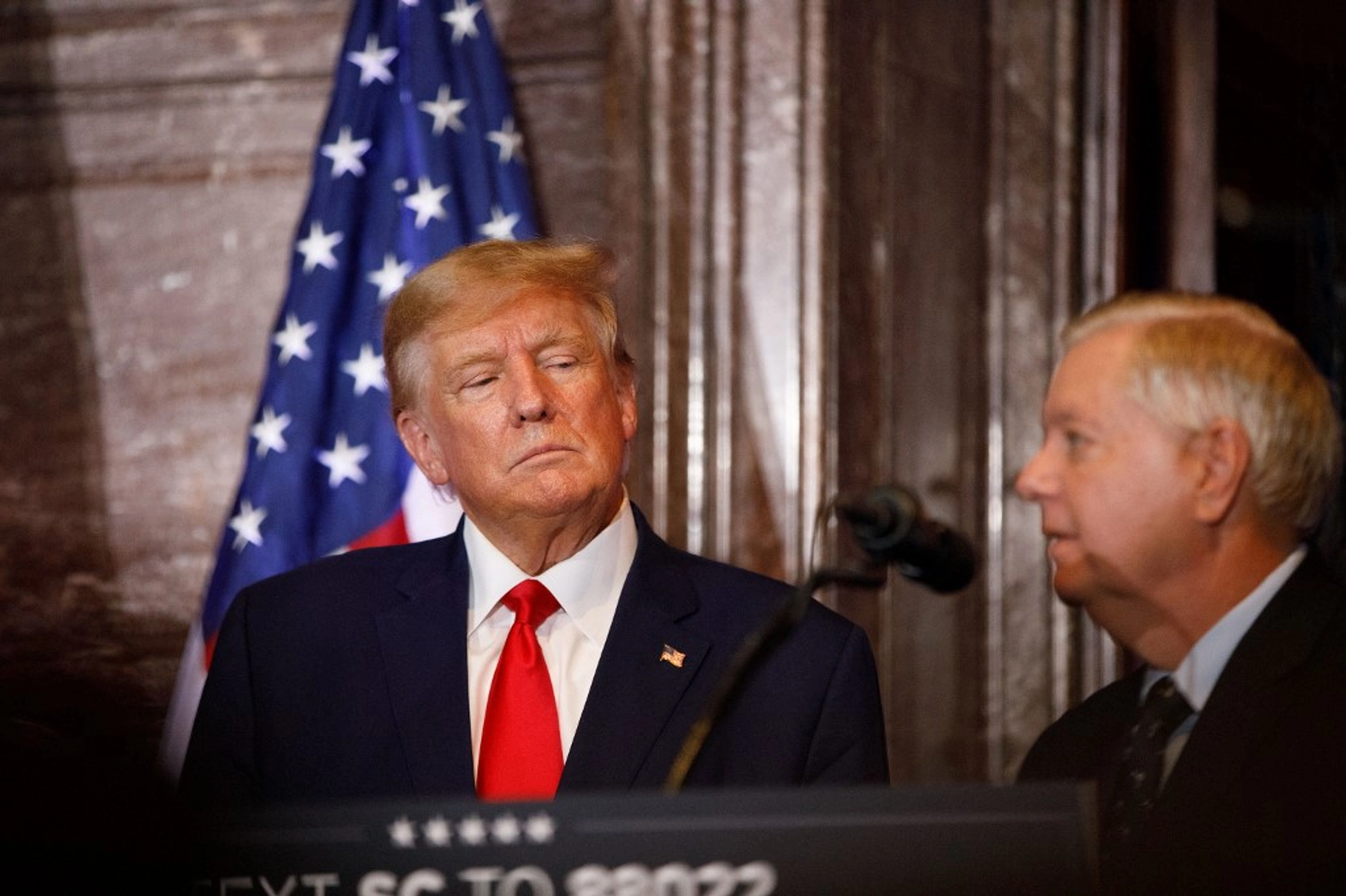 Former US President Donald Trump looks on as US Senator Lindsey Graham (R-SC) addresses the crowd during a 2024 election campaign event in Columbia, South Carolina, on January 28, 2023. (Photo by Logan Cyrus / AFP)
In my April 14 Kyiv Post op-ed, “Trump’s Inner Circle – Who Really Gets Ukraine and Who Doesn’t,” I warned that President Donald Trump’s closest advisors were giving him an incomplete, often dangerously distorted view of Ukraine’s strategic value.
Since then, a subtle but critical shift has taken place. Lived experience, ground truth, and moral clarity are finally starting to pierce the noise.
For too long, figures like Steve Witkoff, who has never visited Ukraine, shaped the conversation with surface-level assessments, emphasizing Russia’s “needs” more than Ukraine’s battlefield realities. Witkoff has traveled to Moscow repeatedly, holding at least three direct meetings with Vladimir Putin in the past month. Yet none of these meetings have produced real progress, only a clearer picture of what Putin demands. Meanwhile, even as these meetings occurred, Putin continued his relentless assaults on Ukrainian civilians with missiles, drones, and guide bombs deep into the country’s interior. The pattern could not be clearer: Putin is not negotiating in good faith. He is escalating while pretending to talk.
Gen. Keith Kellogg has stayed steady throughout. In recent meetings in London and beyond, he has remained focused on a fact-based, experience-driven approach that is now gaining traction with the President. Kellogg’s deep knowledge of Ukraine including battlefield realities, political dynamics, and historical context makes him uniquely capable of clarifying misunderstandings and correcting false assumptions that too often distort policy discussions. His role has become increasingly vital as the administration seeks to navigate the complexities of a potential ceasefire and long-term security guarantees.
Equally important is strong alignment with Gen. Christopher Cavoli, the Supreme Allied Commander Europe and head of US European Command. Gen. Cavoli has emphasized that Ukraine has solved many of its troop challenges and that US military and intelligence support remains essential to sustaining Ukrainian resistance. Together, Kellogg’s ground truth expertise and Cavoli’s strategic command perspective offer the President a balanced, fact-driven foundation for critical decisions ahead.
One of the most important new voices shaping this evolution is Pastor Mark Burns. Pastor Burns spent two weeks in Ukraine earlier this month, witnessing firsthand the devastation inflicted by Russia’s aggression. His deeply personal engagement, coupled with his trusted relationship with President Trump, has become a driving force in re-centering the conversation around moral clarity, strategic strength, and a just peace. Pastor Burns has been quietly and persistently urging the President to focus on a strategy built on enduring American principles: strength, deterrence, freedom, and honor. His influence is reflected clearly in the President’s recent statements questioning Putin’s intentions and pushing for stronger measures like secondary sanctions.
This new alignment was underscored dramatically during President Trump’s historic 15-minute one-on-one meeting with President Zelensky at St. Peter’s Basilica in Vatican City. Zelensky himself called the meeting “very symbolic” and said it had the “potential to become historic” if joint results, specifically a full and unconditional ceasefire, can be achieved.
For the first time, there is real momentum toward a ceasefire framework based on protecting civilian lives, restoring Ukraine’s sovereignty, and preventing future aggression. And President Trump’s own words after the meeting reveal a critical shift:
“There was no reason for Putin to be shooting missiles into civilian areas... It makes me think that maybe he doesn’t want to stop the war... he has to be dealt with differently, through ‘Banking’ or ‘Secondary Sanctions.’ Too many people are dying!!!”
This is a profound and overdue acknowledgment. It reflects a growing recognition that Putin’s war is not about negotiation. It is about domination.
Senator Lindsey Graham immediately reinforced the President’s message, reiterating that the Senate stands ready to move overwhelmingly on secondary sanctions targeting any country that props up Putin’s economy if Russia refuses to embrace an honorable, just, and enduring peace. Graham’s sanctions bill (S.1241), alongside Congressman Brian Fitzpatrick’s companion House bill (H.R.2548), gives Congress a clear legislative pathway to tighten the noose on Russia’s war machine.
President Trump’s instincts are evolving because real, firsthand truth is reaching him.
There is now a new inner circle forming, grounded not in illusions, but in the raw realities of the battlefield. This team understands:
- Victory for Ukraine is not charity. It is critical strategy.
- Stopping Russia in Ukraine prevents wider European war.
- Sustaining Ukraine’s drone, artillery, and air defense dominance accelerates America’s military advantage for the future.
- Weakening Russia directly weakens China’s ambitions.
- Two members of Congress are poised to play an even larger role in this realignment.
Congressman Don Bacon, a retired brigadier general, has long warned against softening America’s stance toward Russia. In the past, he was willing to challenge President Trump’s positions when they leaned too far toward appeasement. But today, with the ground shifting fast, and with the president recalibrating after Rome, Bacon’s voice will be essential.
Congressman Brian Fitzpatrick, fresh from Ukraine’s front lines, brings unmatched credibility as a former FBI agent and national security expert. His co-sponsorship of H.R.2548 reflects the seriousness with which he views Ukraine’s fate and its direct tie to American security.
Both Bacon and Fitzpatrick will be instrumental in drafting a strong Memorandum of Understanding (MOU) or Memorandum of Agreement (MOA) once a ceasefire is achieved, agreements that must be far more enforceable and durable than the Budapest Memorandum or the failed Minsk agreements.
The Ambassador post to Ukraine will also be pivotal. The right ambassador must bring lived ground experience, strong trusted ties in Ukraine, credibility across Congress, and strategic toughness to guide the ceasefire negotiations into an enforceable, lasting peace.
Beyond Washington, the American people themselves have made their position clear. Across political divides, Americans have shown they have no interest in appeasing Putin’s aggression. They recognize that allowing Russia to succeed will embolden China, a reality that is already playing out today.
Just this week, China launched major new military drills around Taiwan’s airspace and territorial waters, simulating attacks and full-scale blockades. These escalations are a direct signal: weakness in Ukraine will be seen as weakness everywhere. If Putin succeeds, Xi Jinping will press his advantage even harder in Asia, in the Arctic, and beyond.
In this moment, something even more profound is happening, moral clarity is beginning to surface. For leaders like Pastor Mark Burns, Senator Lindsey Graham, Congressman Don Bacon, and Congressman Brian Fitzpatrick, moral clarity has always been at the center of the fight. It has been the driving force for Ukraine itself and for President Zelensky, who for so long depended on bureaucratic processes and political calculations in Washington.
What the world saw in Rome was something different. President Trump engaged with President Zelensky at a deeply human level, not as a transactional ally but as a leader gaining firsthand moral clarity about what Ukraine has endured. For the first time, Zelensky may have sensed that he was speaking with a president who truly wants to end the war, save lives, and seek a just peace, one that honors the victims, not the aggressor.
It is a shift not just in strategy but in spirit. It is the shift that could finally turn the tide.
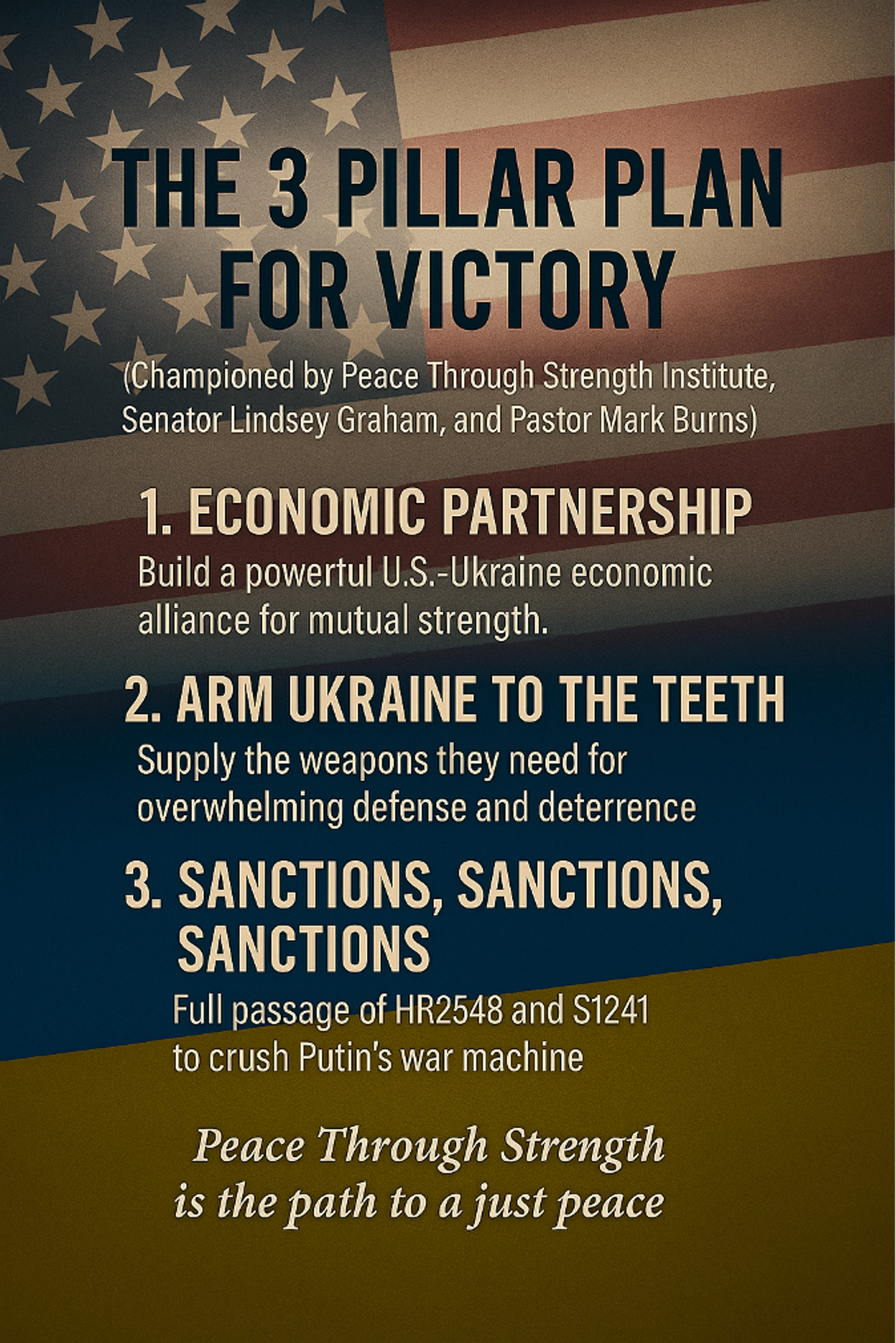
Fortunately, a serious and credible peace blueprint already exists: the Three Pillar Peace Plan, championed by Pastor Mark Burns, Senator Lindsey Graham, and the Peace Through Strength Institute:
- Economic partnership to bind Ukraine’s future to the West,
- Arming Ukraine to the teeth for enduring security,
- Relentless sanctions on Russia until its imperial ambitions are broken.
This is how Ukraine wins. This is how America wins.
President Trump’s instincts are evolving because real, firsthand truth is reaching him. Victory is within reach but only if America finishes the realignment that has begun.
The world is watching. The stakes could not be higher. This moment demands leadership guided by courage, clarity, and strength.
History will remember if we rose to meet it or shrank from the fight when it mattered most.