
OPINION: Trump’s Inner Circle – Who Really Gets Ukraine and Who Doesn’t
Among those who have Trump’s ear, some are experienced in international relations while other are relative neophytes. Here’s a who’s-who of the Ukraine-advisors frequenting the White House.
 Originally published at Kyiv Post on Apr 14, 2025
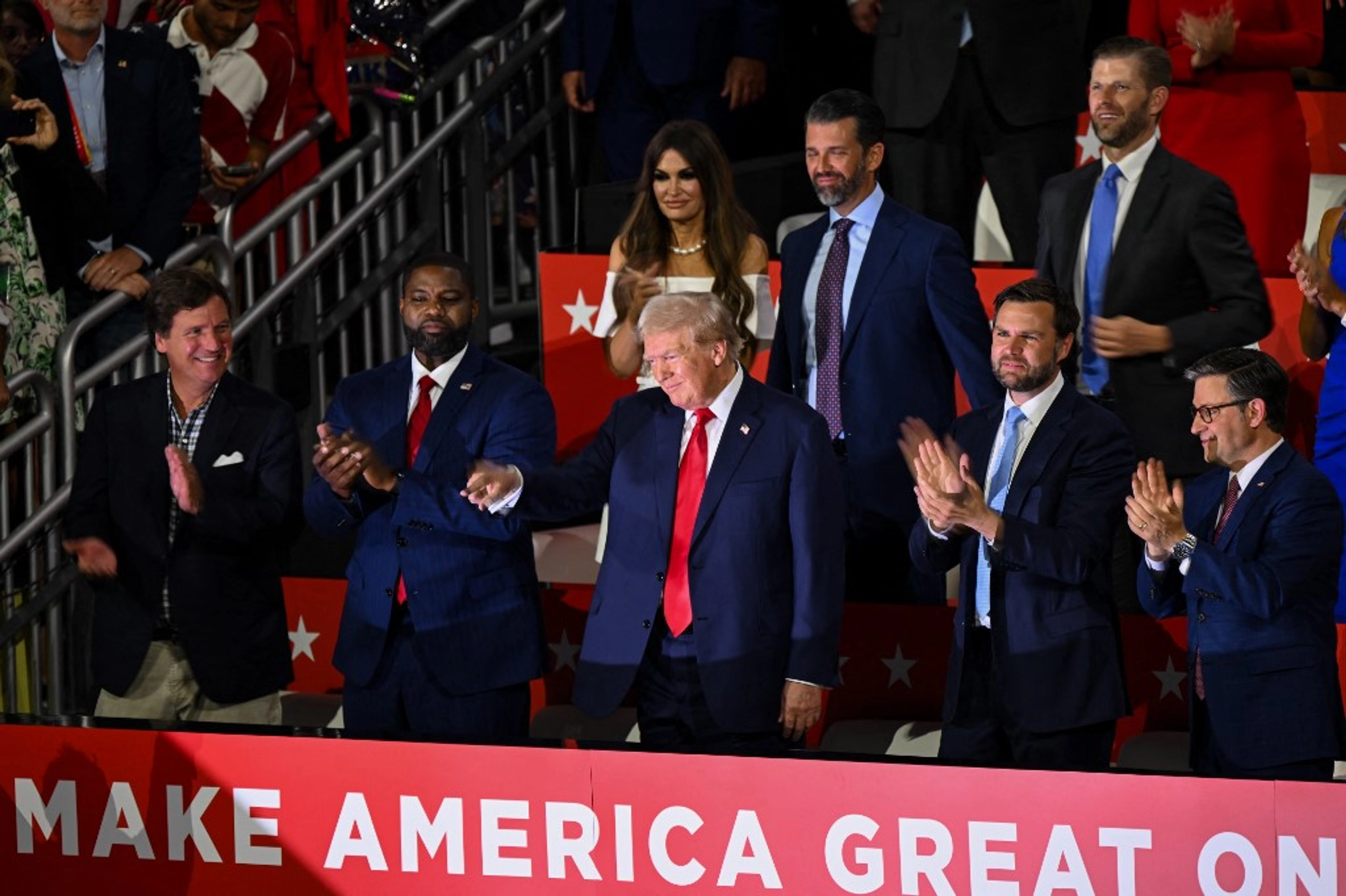 Former US President and 2024 Republican presidential candidate Donald Trump (C) points while standing with (L-R) US commentator Tucker Carlson, US Representative of Florida Byron Donalds, US Senator from Ohio and 2024 Republican vice-presidential candidate J. D. Vance (2R), and House Speaker Mike Johnson (R), as (Rear L-R) US TV news personality Kimberly Guilfoyle sons Donald Trump Jr., and Eric Trump stand behind them during the first day of the 2024 Republican National Convention at the Fiserv Forum in Milwaukee, Wisconsin, July 15, 2024. (Photo by Patrick T. Fallon / AFP)
President Trump’s remarks on Ukraine last week raised serious concerns about the quality of information reaching the highest levels of our government. During an Oval Office meeting with Israeli Prime Minister Benjamin Netanyahu, he expressed his discontent with the war, stating: “I’m not happy about what’s going on with the bombing because they’re bombing like crazy right now. They’re bombing – I don’t know what’s happening there.”
That sentence should alarm anyone paying attention. It doesn’t reflect a policy stance – it reflects a vacuum. A vacuum created by the people around the President, who either aren’t briefing him regularly or are feeding him a distorted or dangerously incomplete narrative.
I was in Washington, DC, holding meetings on Capitol Hill when President Trump made that statement. And in every meeting we had – Republican and Democrat alike – there was a shared concern: he is not getting the ground truth.
Having spent 90 days in Ukraine over the past 16 months – traveling from Kramatorsk to Kharkiv, meeting with frontline troops, civic leaders, doctors, and ministers – I’ve seen firsthand the difference between what’s happening on the ground and what’s being said in Washington. And in the rooms that matter, that disconnect is dangerous.
Let me be clear: I agree with President Trump that the war must end. The killing must stop. But how it ends matters. The path forward must be just – and it must reflect the desires of the Ukrainian people, who have endured unimaginable suffering while defending their sovereignty. Anything less invites the next war.
Here’s a candid report card on the voices shaping that conversation within the President’s inner circle:
Mr. Steve Witkoff
On April 11, Mr. Witkoff met directly with Russian President Vladimir Putin in St. Petersburg – his third meeting with the Russian leader in recent months. During the meeting, he advocated for the US to support Russia’s claims to four Ukrainian regions – Donetsk, Luhansk, Zaporizhzhia, and Kherson – as part of a ceasefire deal. That’s not diplomacy – it’s surrender. Ending the killing is a noble aim, but proposing to hand over sovereign Ukrainian territory isn’t peace – it’s appeasement. It sets a dangerous precedent, signaling to authoritarian regimes that aggression yields reward.
Mr. Tucker Carlson
Still one of the loudest voices in the President’s orbit. Mr. Carlson’s hostility toward Ukraine and embrace of Kremlin narratives gives cover to authoritarian expansion. His influence is real – and dangerous.
The Honorable Scott Bessent – Secretary of the Treasury
Secretary Bessent isn’t antagonistic toward Ukraine, but his approach is purely transactional. As Treasury Secretary, his emphasis on “dealmaking” over long-term deterrence and strategic investment presents risks. Ukraine is not a business model – it’s a frontline for global stability.
The Honorable Mike Waltz – National Security Advisor
National Security Advisor Waltz is one of the few who deeply understands the military and strategic stakes in Ukraine. A former Green Beret and respected leader, he has long spoken with clarity about the need to contain Russian aggression. His job now is to ensure that the President receives unfiltered, fact-based assessments – not oversimplified talking points. The weight of peace – and its consequences – rests on his desk.
The Honorable Marco Rubio – Secretary of State
Secretary Rubio knows the issue well and has long understood the geopolitical risk of a victorious Russia. But now, as America’s top diplomat, he must shift from caution to leadership. Ukraine doesn’t need sympathy – it needs support, strategy, and strength.
Senator Lindsey Graham The steady hand. Senator Graham has visited Ukraine nine times and has advocated for a US-Ukraine economic partnership since the Obama administration. He understands the war must end justly, and that peace must be followed by strength and long-term investment – not retreat.
Representative Don Bacon
A retired Brigadier General and respected member of Congress, Representative Bacon has consistently reminded Washington that helping Ukraine is not foreign charity – it’s defending US national security. He has done so with clarity and courage, even when it came at political cost.
General Keith Kellogg (Ret.)
A respected military strategist with deep national security experience. But on Ukraine, General Kellogg’s recent positions – particularly around conceding territory – suggest a troubling disconnect from the realities on the ground. Like Mr. Witkoff, he seems focused on ending the war quickly rather than ending it justly. That mindset misreads both Ukraine and the stakes for America.
Vice President JD Vance
Vice President Vance sparked outrage during a televised Oval Office meeting on Feb. 28, 2025, when he sharply criticized President Zelensky and questioned Ukraine’s gratitude. The confrontation ended a planned minerals agreement. Yet more recently, in Greenland, he accurately described Russia as an “imminent threat” to the United States. That acknowledgment should frame the war against Ukraine for what it is: an America First issue. If Ukraine weakens Russia, it strengthens us – and forces China to think twice about Taiwan. Especially now, as captured Chinese soldiers have begun to surface on the Ukrainian battlefield, the stakes for US global security could not be clearer.
Pastor Mark Burns
A newcomer to the Ukraine conversation – but an important one. Pastor Burns recently traveled to Ukraine to see the war for himself. Like me, he chose not to rely on headlines or filtered briefings. He walked the streets, met the people, and asked questions. Given his strong relationship with President Trump and his rising voice in conservative America, he may end up playing a critical role in helping the faith-driven base understand what’s at stake.
And now, a critical vacancy looms
With Ambassador Bridget Brink’s resignation, the United States loses its diplomatic anchor in Kyiv. This is not a ceremonial post – it’s a frontline position in the war for regional stability and global alignment.
We need someone with firsthand experience in Ukraine, who has walked the ground and built trusted relationships. Someone with an empathetic disposition – earned through time spent in-country – not manufactured from a briefing memo. But empathy is not enough.
This role demands conservative roots, business sense, and strategic clarity. The next ambassador must be able to work directly with President Trump and his senior team to chart a just peace – one that defends American interests while respecting the will of the Ukrainian people. They must also be ready to manage the next chapter: a US-Ukraine economic partnership that can drive innovation, rebuild cities, expand energy cooperation, and lock in long-term security across the region.
This seat is more than symbolic. It is the bridge between Kyiv and Washington. And it must be built to last.
At this moment, we don’t need soundbites or showmanship. We don’t need career diplomats or bureaucrats who play it safe. We need leadership. Leaders who’ve stood in the mud with Ukrainians. Leaders who understand what victory – and lasting peace – actually require.
President Trump needs that clarity. So does America.