
OPINION: Operation Spiderweb Is the Future of War – and America Isn’t Ready
The United States treats the war in Ukraine as a problem to be managed. But Putin is the problem. For America’s own security, it needs to consider Kyiv a partner to be empowered.
 Originally published at Kyiv Post on Jun 5, 2025
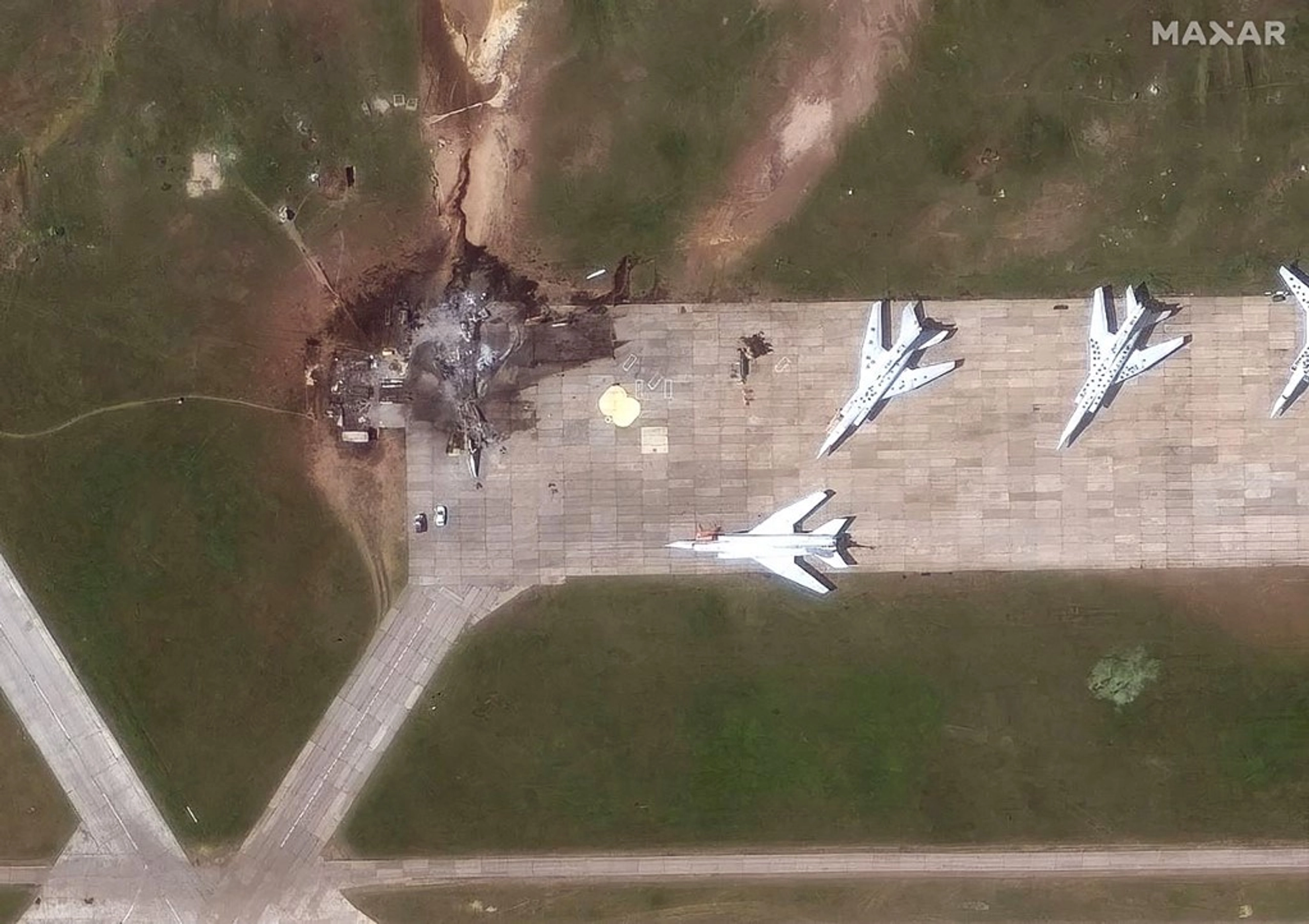
This handout satellite picture courtesy of Maxar Technologies released on June 4, 2025 shows a destroyed Tupolev Tu-22 aicraft at Belaya Airbase in the Irkutsk Oblast. Ukraine said June 1, 2025 it destroyed Russian bombers worth billions of dollars as far away as Siberia, in its longest-range assault of the war as it geared up for talks on prospects for a ceasefire. (Photo by Satellite image ?2025 Maxar Technologies / AFP)
In my previous April 2024 article, “US Blind Spot in the Drone War,” I warned that the United States was underestimating the scale and urgency of drone warfare. Operation Spiderweb has only reinforced that warning, and the consequences of inaction are growing.
Ukraine has just executed one of the most significant military operations of the 21st century and most people barely noticed.
With a fraction of the resources, using cheap, disposable drones, Ukraine’s Operation Spiderweb delivered billions of dollars in losses to Russia’s military. Fighter jets, bombers, and air defense systems, have all been destroyed by low-cost, high-impact weapons.
This isn’t just innovation. It’s a revolution. Drone warfare is here, and it’s reshaping the battlefield faster than Washington seems willing to admit.
The United States has a dangerous blind spot. While Ukraine adapts and innovates in real time, US policymakers remain stuck in outdated models of warfare. The White House and the Pentagon have hesitated where they should be moving full speed ahead, not just supplying Ukraine, but learning from Ukraine.
Ukraine’s battlefield is a laboratory for future war. Every FPV drone that disables a Russian tank, every drone boat that sinks a billion-dollar warship, every swarm that overwhelms a state-of-the-art air defense system is proof. Small investments. Outsized destruction. This is asymmetric warfare at its finest.
But Operation Spiderweb isn’t just a lesson for the battlefield. It’s a warning for the home front. What Ukraine demonstrated, with just a few million dollars’ worth of FPV drones, is that massive strategic assets can be destroyed quickly, cheaply, and with devastating effect: 117 drones wiped out more than $7 billion worth of Russian aircraft. Think about that: a few thousand dollars of hardware obliterating some of the most expensive assets a modern military can field.
Now imagine what $50 million or $100 million could do, amounts well within reach of hostile regimes or terrorist organizations. This kind of swarm attack could come from anywhere: a rogue state like Iran targeting Israel, Russian operatives striking US military bases in Germany, or something closer to home, smuggled through our southern border or launched from trucks already on US soil. And the risk doesn’t stop there. Imagine a Chinese freighter ship off the US coast launching thousands of FPV drones in a coordinated swarm attack, or think back to the Chinese surveillance balloon that crossed over the United States in January 2023. What if it had been packed with drones, ready to burst out like a swarm of spiders? Operation Spiderweb shows that for a fraction of what conventional warfare costs, catastrophic damage can be inflicted and in ways we are not prepared to defend against.
Drone warfare isn’t optional. It’s inevitable. Operation Spiderweb has shown what the future looks like.
Operation Spiderweb is proof that drone warfare has erased traditional distances and defenses. It has democratized destruction.
Yet the White House and the Department of Defense continue to misread the stakes. They treat Ukraine like a problem to be managed, not a partner to be empowered. They fail to grasp that Ukraine’s victories are not just Ukrainian victories, they are previews of how tomorrow’s wars will be fought. Every missed opportunity to invest, co-develop, and learn is a step backward for US security.
The warnings have been clear. Four years ago, Congressman Don Bacon circulated a white paper warning that unmanned aerial systems (UAS) would define the next era of conflict. He emphasized the need for a coherent, aggressive strategy to master drone warfare before America fell behind. That warning, like too many others, was ignored.
Meanwhile, Russia, China, Iran, and North Korea are learning. They are adapting. We are not.
Even now, the wrong signals are being sent. US President Donald Trump’s decision not to send Defense Secretary Pete Hegseth to the Ukraine Defense Contact Group this week was not just a diplomatic blunder, it was a dangerous sign of disengagement. And while Trump has long championed peace through strength, there is growing concern that he is not hearing the ground truth about modern warfare. Instead of adapting to the realities Ukraine is revealing, his team continues to cling to outdated assumptions. Drone warfare will define the next major conflict. There will be no second chance to get it right.
Congress is starting to wake up. Some leaders finally realize that Ukraine isn’t just a cause, it’s an investment in American security. But the White House and Pentagon have been slow to adapt.
This moment is an opportunity. The economic partnership already in place between the US and Ukraine can be expanded, not just with financial aid, but with a focused, strategic alliance around drone technology, battlefield innovation, and the rapid integration of artificial intelligence. Ukraine’s engineers are already adding significant AI capabilities to drones, enhancing autonomy, targeting, and decision-making in ways that even our defense sector is struggling to match. These are the kinds of breakthroughs the United States should be building upon, leveraging Ukraine’s ingenuity to create a unique military partnership, and together, developing the most advanced joint drone army on earth, setting a standard Russia, China, and Iran cannot match.
Drone warfare isn’t optional. It’s inevitable. Operation Spiderweb has shown what the future looks like, not just abroad, but potentially here at home. The only question now is whether America will seize this moment or whether we will pay the price in the lives of young American soldiers, and possibly American civilians, facing tomorrow’s wars with yesterday’s defenses.
Drone warfare is borderless. So is the danger of ignoring it.